Fomors
Vainqueur the DragonThe Fomors are the ancient fairy lords of Outremonde and the central ancestral threat behind the coming Wild Hunt. They are not benevolent storybook fairies but a soulless ruling people defined by predation, enslavement, and a political vision of restoring the world to the dominion of the Old Folk. Their significance lies in the scale of that project: the Fomors seek not merely to defeat current kingdoms, but to erase the civilizations that replaced them and carry the war beyond Outremonde to Earth.
Origins and Ancient Rule
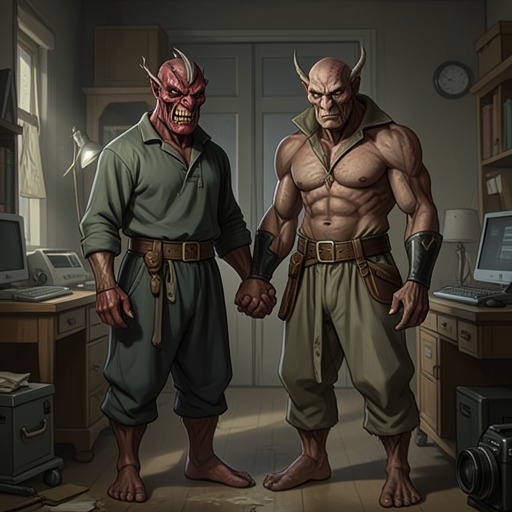
The Fomors are described as soulless abominations, wicked witches, child-eaters, and cruel giants who treated humans as toys or food. They created life for the purpose of enslaving it, and their relationship with other species was organized around domination rather than coexistence. They even uplifted the Beastkin by granting animals intelligence, only to hunt those intelligent descendants for sport. Creation, in their hands, becomes another instrument of ownership: the power to make life carries no corresponding recognition of life’s autonomy.
In the ancient past, the Fomors ruled Outremonde with an iron fist alongside their dragon rivals. Their supremacy was eventually challenged when the gods and the power of Classes enabled humans and other species to resist them, gradually forcing them into a dark corner of the world. The conflict therefore has a historical dimension beyond the immediate struggle between monsters and mortals. It is a contest between the Old Folk, who claim ancestral ownership of the land, and the New Folk, whose societies have developed under divine guidance and the Class system.
The Fomors’ retreat was not an uncomplicated defeat. Their survival preserves an older political order beneath the visible world, while their hatred of the newer civilizations grows in proportion to their lost authority. The deity Leone explains that the Fomors are an ancient foe of Outremonde’s peoples, and that their return represents a threat serious enough for the gods to recruit champions from Earth rather than confront the enemy directly.
Ideology and Methods
The Fomors define mortal magic as a disease and mortals themselves as vermin carrying it. Their stated remedy is extermination. They intend to hunt the New Folk into their houses, kill them with their families around them, and restore Outremonde to a condition in which the Old Folk rule without opposition. This rhetoric turns conquest into purification: violence is presented not as a political choice but as a cure for contamination.
Their methods combine military force, biological creation, secrecy, and manipulation. Mag Mell, who calls himself the Father of Monsters, created many of the creatures deployed against dragons during the ancient war, including trolls and werewolves. The Fomors thus possess a power that is both generative and destructive: they can manufacture armies and beasts while regarding those creations as resources. They also claim to be able to raise gold from the air and shape slaves from dirt, making material abundance and forced labor extensions of their supernatural authority.
Individual Fomors operate indirectly as well as openly. Mell Odieuse, who used the human-facing name Melodieuse, works through agents and engineered conflicts. She empowered Maure with knowledge while hoping that Maure and Gardemagne would destroy one another, leaving the Fomors as the only victors. Her strategy is characteristic of Fomor power: preserve distance, foster chaos, and allow rival societies to exhaust themselves before the ancient enemy steps forward. Her secrecy is reinforced by the hidden gate behind her throne, the greatest and most secret Fomor treasure, which leads to Earth.
The Wild Hunt and the Threat to Earth
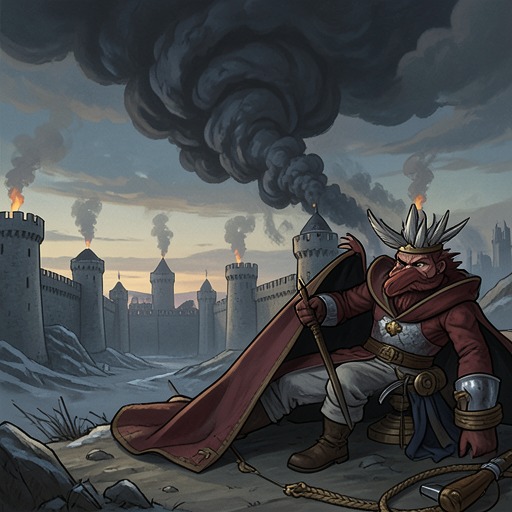
The Fomors’ renewed offensive is announced by Mag Mell as a Great Wild Hunt. He claims that a horde numbering in the millions will gather to spill the blood of mortals, kill the last of them, and then take the war to their nest on Earth. The objective is therefore openly genocidal and interworld in scope. Outremonde is to be reclaimed first; Earth is to become the next battlefield and, by implication, the next territory of the Old Folk.
The campaign is associated with Mighty King Balaur, identified as the Fomors’ champion and the strongest of their kind. Mag Mell presents Balaur as a figure whose hatred has grown with time, contrasting Vainqueur Knightsbane’s dismissive memory of him with the danger he now represents. The appeal to Vainqueur Knightsbane is also revealing. Mag Mell offers fairy gold and mortal flesh in exchange for the dragon’s participation, assuming that shared hostility toward mortals can overcome the historic antagonism between dragons and Fomors.
Vainqueur Knightsbane rejects the offer for practical as well as moral reasons. He refuses to trust a Fomor and points out that exterminating the lesser races would destroy his own access to favorite foods, coins, and princesses. His response exposes a structural opposition within the conflict: the Fomors imagine a purified world without competing peoples, while Vainqueur Knightsbane, despite his predatory rule, depends on a populated world to supply a hoard, subjects, food, and opportunities for glory. The dragon’s refusal leaves the Fomors without the powerful ally they hoped to recruit.
Encounters with the New Folk
The Fomors’ hostility shapes the behavior of monsters living under the New Folk order. Croissant explains that monsters disguise themselves as humans because inquisitors and adventurers regularly attempt to wipe them out. The community maintains a school where mimics and other shapeshifters learn to blend into a safe environment, while Chocolatine’s cheerful suggestion that enemies should be killed in their sleep reveals the defensive violence produced by constant persecution. The Fomor threat thus operates even when no Fomor is physically present: it contributes to a world of concealment, suspicion, and preemptive brutality.
Fomor influence also appears in the history of Ishfania. The Sablaris, a dark elf empire, turned the region into a red desert through a magical cataclysm undertaken in service of universal entropy. Afterward, Brandon Maure, the offspring of a demon lord and a dark elf, ruled the ruins with summoned monsters. Although the evidence distinguishes the Sablaris catastrophe from the Fomors’ own schemes, the connection places the Fomors within a wider history of ancient powers that transform whole regions into wastelands and use created monsters as instruments of rule.
Their antagonism with Vainqueur Knightsbane becomes explicit when Mag Mell confronts him in the countryside. Mag Mell appears as a deformed centaur-like creature with a spider’s lower body, insect armor, a bladed centipede arm, a crimson hand, eight multicolored eyes, and pointed teeth. The grotesque body materializes the Fomors’ association with unnatural creation, while the title Father of Monsters establishes him as an agent responsible for manufacturing the dragon-hunting beasts of the old wars.
Organization, Conflict, and Narrative Role
The Fomors function less as a conventional army than as an ancient civilization, a species-wide political project, and a network of specialized agents. They possess kings, champions, teachers, creators, spies, magical treasures, and long-term plans. Mell Odieuse’s manipulation of Maure and Mag Mell’s recruitment of Vainqueur Knightsbane show two complementary modes of action: covert destabilization and open ideological mobilization. Together they make the Fomors an organization capable of operating through both conspiracy and mass war.
Their conflict with the New Folk is built on irreconcilable claims to legitimacy. The Fomors regard modern mortal and monster societies as pollution occupying lands that belong to the Old Folk. The New Folk, by contrast, have survived the ancient regime, developed classes and institutions, and begun to organize politically through settlements, adventurer states, and alliances. The struggle is therefore not simply good against evil in military terms; it is also a collision between ancestral entitlement and constructed citizenship, between a world where life is property and one where different species attempt to build shared institutions.
Mag Mell’s final warning is delivered on the solstice. He predicts that the New Folk will eventually come for Vainqueur Knightsbane and his kind as well, even after the dragon refuses the alliance. The warning preserves the Fomors as an approaching rather than completed catastrophe. Mag Mell vanishes into the earth, leaving the threat unresolved, while Vainqueur Knightsbane returns to shopping. That comic refusal to match the scale of the prophecy is central to the Fomors’ narrative role: they embody an apocalyptic future whose seriousness is undeniable, even when the dragon’s appetite, vanity, and immediate concerns repeatedly deflect the expected heroic response.